
Frequently Asked Questions
About Raphael House
Raphael House is a Rudolf Steiner (Waldorf) school in Aotearoa New Zealand offering a holistic, developmentally aligned education for children from early childhood through to senior secondary years.
Our approach supports the growth of the whole child — thinking, feeling, and willing — through a rich curriculum that integrates academic learning with the arts, practical skills, movement, nature connection, and social responsibility.
We aim to spark a lifelong love of learning while nurturing capable, compassionate, and resilient young people who can contribute meaningfully to the world around them.
Waldorf Steiner education is based on an understanding of child development and seeks to educate the whole human being.
Key principles include:
Developmentally aligned learning
Teaching is matched to the developmental stages of childhood and adolescence.
Education of head, heart, and hands
Intellectual, emotional, and practical capacities are nurtured together.
Imagination and creativity
The arts are central to learning across all subjects.
Relationships and belonging
Strong, respectful relationships support learning and wellbeing.
Rhythm and balance
Learning includes movement, creativity, reflection, and academic challenge.
Learning for life
Education aims to cultivate curiosity, resilience, ethical awareness, and social responsibility — not just academic success.
Steiner education is not religious and does not promote any particular faith.
It is grounded in a view that education should support the full development of the human being — including meaning, values, connection, and purpose.
While the philosophy behind Waldorf education recognises that human beings seek deeper understanding and connection, our teaching is inclusive and respectful of all cultural, spiritual, and secular worldviews.
At Raphael House, we honour the diverse beliefs of our families and embrace the bicultural context of Aotearoa New Zealand, including values such as:
connection
responsibility
wellbeing
community
Steiner education differs in several key ways
The intention is not to move faster, but to educate more deeply — helping young people become adaptable thinkers, capable collaborators, and purposeful contributors to society.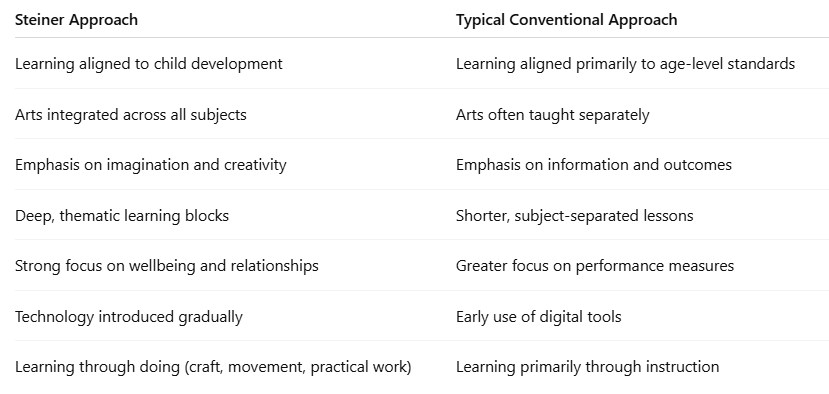
Curriculum and Learning
Our curriculum is structured to support children’s developmental stages while also meeting the expectations of the New Zealand Curriculum.
Learning is delivered through a blend of:
Main Lesson blocks – in-depth thematic learning (e.g. science, history, mathematics) taught over several weeks
Practice lessons – literacy and numeracy skills taught regularly and progressively
Specialist subjects – including arts, handwork, music, movement, languages, and practical skills
Experiential learning – camps, performances, outdoor education, and community engagement
Subjects are connected rather than taught in isolation, helping students see relationships between ideas and apply learning meaningfully.
At Raphael House, literacy and numeracy are taught through a structured and explicit approach within a rich, meaningful context.
Literacy
We use:
Structured literacy teaching (including phonics and decoding)
Rich oral language and storytelling
Writing linked to curriculum themes
Reading development supported through clear learning progressions
Students build strong foundations in:
phonological awareness
spelling and grammar
comprehension
written expression
This is combined with creativity and imagination to support both technical skill and love of language.
Numeracy
Mathematics is taught through:
Explicit teaching of number knowledge and strategies
Hands-on materials and visual models
Real-life problem solving
Pattern, movement, and practical application
Students develop both:
conceptual understanding
procedural fluency
Yes.
Our curriculum is designed to meet the learning outcomes of the New Zealand Curriculum while being delivered through a Steiner-informed approach.
Our aim is that students develop not only academic competence but also:
independence
creativity
resilience
social responsibility
Technology is introduced in a thoughtful and age-appropriate way.
In the early years, learning focuses on:
hands-on experiences
real-world interaction
creativity and movement
Digital technology is gradually introduced in the middle and senior years to support:
-research
-communication
-subject learning
-preparation for further study and the modern world
The goal is for students to become confident, capable users of technology — rather than passive consumers.
Assessment at Raphael House is designed to support learning and growth.
We use a range of approaches, including:
-classroom observation
-skill-based assessments
-learning progressions
-student work samples
-projects and presentations
Students receive:
-regular feedback
-written learning posts through Hero
-clear next steps for development where appropriate
Assessment focuses on understanding each student’s progress over time — supporting both academic development and personal growth.
Wellbeing, Safety & School Environment
At Raphael House, behaviour is understood as communication.
We use a relational and restorative approach that seeks to understand the needs behind behaviour, rather than relying on punishment.
Our approach is informed by:
Collaborative & Proactive Solutions (CPS) — a research-based framework that helps adults and students work together to:
-understand challenges
-build skills
-develop shared solutions
This means we focus on:
-teaching emotional regulation
-strengthening problem-solving skills
-maintaining dignity and belonging
The goal is not compliance, but growth — helping students develop responsibility, self-awareness, and the ability to repair relationships.
We take bullying seriously and respond in ways that are both firm and constructive.
Our response focuses on:
-understanding the dynamics involved
-ensuring safety for all students
-addressing underlying needs
-rebuilding healthy relationships
We use restorative and CPS-informed conversations alongside clear expectations about respectful behaviour.
Where needed, support is coordinated through our Pathways Team, which brings together staff to plan and implement appropriate supports.
We recognise and value the diverse ways children learn and experience the world.
Support is coordinated through our Pathways Team, which oversees personalised approaches for students who may benefit from additional support.
Interventions may include:
-1:1 or small-group learning support
-Highly trained Learning Support Assistants
-Adjustments to classroom approaches
-Therapeutic supports such as:
Art Therapy
Music Therapy
Eurythmy Therapy
Footbath Therapy
Our aim is to support students to:
-participate fully in learning
-develop confidence and capability
-feel understood and included
Student wellbeing is supported through several interconnected layers.
These include:
Pathways Team
A dedicated team that coordinates:
-learning support
-therapeutic interventions
-wellbeing responses
Learning Support
Students may receive:
-1:1 support
-small-group support
from highly trained Learning Support Assistants.
Therapeutic Supports
Where appropriate, students may access:
-Art Therapy
-Music Therapy
-Eurythmy Therapy
-Footbath Therapy
Pastoral Leads
A team of pastoral leaders supports:
-emotional wellbeing
-social relationships
-transitions
-family partnership
Together, these structures ensure that students are supported not only academically, but socially and emotionally — helping them to feel safe, connected, and able to learn.
Teacher Qualifications, Training and Support
Teachers at Raphael House hold recognised teaching qualifications and are registered with the Teaching Council of Aotearoa New Zealand.
In addition, many of our teachers undertake specialist training in Steiner education, supporting their ability to deliver our holistic, developmentally aligned curriculum.
This combination of:
-professional teaching qualifications
-Steiner pedagogical training
ensures that students receive both high-quality teaching and an approach grounded in the values and practices of Waldorf education.
Teaching quality is supported through a structured professional growth and review process.
All teaching staff:
-work toward the Teaching Standards for the Profession
-engage in regular professional reflection
-receive feedback and support from experienced leaders
Each teacher is supported by a Learning Coach from the leadership team and meets with them regularly throughout the year to reflect on practice, progress, and professional goals.
This process ensures teaching remains:
-effective
-responsive to student needs
-aligned with both curriculum expectations and the school’s special character
We are committed to ongoing professional learning.
Teachers are supported to undertake:
-Steiner pedagogical training
-curriculum-specific development (e.g. literacy and numeracy)
-wellbeing and inclusive education training
Professional learning is supported through:
-mentoring and coaching
-internal workshops
-external courses and conferences
This ensures teachers continue to grow in their practice — benefiting both students and the wider school community.
Communication With Parents
We see education as a partnership between school and home.
We communicate with families through a range of channels, including:
-school-wide communications- OUR Bush telegraph Weekly and other posts through Hero
-regular class updates and newsletters
-learning posts and updates through Hero
-parent meetings and learning conversations
Teachers also hold class meetings to share:
-curriculum themes
-developmental aims
-upcoming learning experiences
These opportunities help families understand not just what is being taught, but why.
We encourage open and respectful communication.
Parents are asked to raise any concerns in the first instance with their child’s teacher, as they know the student best and can often resolve matters quickly.
If further support is needed, concerns can be discussed with:
-team leads
-school leaders
-the principal
Our aim is always to:
-listen carefully
-work collaboratively
-find constructive solutions
Student progress is shared in ways that reflect both academic learning and personal development.
Families receive:
-regular learning posts through Hero
-regularly updated learning goals through Hero
–teacher conversations
Leanring posts include:
-strengths
-areas for growth
-next steps
Assessment focuses on progress over time, helping families understand how their child is developing both as a learner and as a person.
Financial Matters
Raphael House is a state-integrated school.
This means we receive government funding for teaching and learning in the same way as other state schools.
However, like all integrated schools, we are responsible for maintaining and developing our special character buildings and facilities.
Because these are not funded by the government, families contribute through attendance dues and voluntary donations.
Together, these funding streams support:
-quality teaching and learning
-specialist facilities
-our unique learning environment
Attendance dues are a compulsory payment set by the Proprietor and approved by the Ministry of Education.
These dues contribute to the costs of:
-maintaining and improving school buildings
-specialist learning spaces
-long-term property development
Attendance dues are not school fees and do not fund teaching or classroom learning.
They ensure the sustainability of the school’s special character environment.
School donations are voluntary contributions that support the wider life of the school.
These donations help provide:
-enriched learning experiences
-additional resources
-special character teaching and learning
This includes elements that are central to a Steiner education but are not fully covered by government funding, such as:
-festivals and seasonal celebrations
-specialised stationery and learning materials
-arts, handwork, and practical curriculum resources
While donations are not compulsory, they make a meaningful difference in supporting the full breadth of learning experiences we offer.
Diversity, Inclusion & Te Tiriti o Waitangi
Raphael House recognises Te Tiriti o Waitangi as foundational to education in Aotearoa New Zealand.
We seek to honour Te Tiriti by:
-valuing partnership with whānau
-fostering a sense of belonging and shared responsibility
-integrating te reo Māori and tikanga into school life where appropriate
We aim to nurture respect for:
people
place
culture
This includes supporting students to develop an understanding of Aotearoa’s history, identity, and the importance of working together for collective wellbeing.
We are committed to creating a learning environment where every student feels valued, supported, and able to participate fully.
Inclusion is supported through:
-our relational and strengths-based approach to behaviour
-personalised learning support coordinated by our Pathways Team
-pastoral care structures that respond to individual needs
Students may receive:
-1:1 or small group learning support
-therapeutic supports such as art therapy, music therapy, and eurythmy therapy
Our aim is to ensure that all students — including neurodiverse learners — are supported to:
-learning
-build confidence
-experience a sense of belonging
Addressing Common Misconceptions
No.
Steiner education values scientific inquiry and seeks to develop students’ curiosity, observation skills, and critical thinking.
Students engage with science through:
-hands-on investigation
-careful observation
-conceptual understanding
Our approach aims to build deep understanding rather than rote learning.
We also respect modern medicine and encourage families to seek appropriate medical advice from qualified health professionals.
No.
Vaccination is a personal decision for families and is guided by public health advice.
Raphael House does not promote or discourage vaccination.
We follow all Ministry of Education and public health requirements and support families to make informed decisions in consultation with their healthcare providers.
Yes.
Steiner education aims to educate deeply as well as broadly.
Students develop strong capabilities in:
-literacy
-numeracy
-scientific understanding
-critical thinking
The curriculum is designed to meet New Zealand learning expectations while also nurturing creativity, problem-solving, and resilience.
Academic learning is integrated with:
-analytical thinking
-creativity
-practical application
Steiner education began in Europe in the early 20th century and, like many historical movements, reflects the context of its time.
Modern Steiner schools — including Raphael House — are committed to equity, inclusion, and respect for all people.
Our focus today is on:
-the dignity and potential of every human being
-cultural respect and belonging
-education for social responsibility
We work consciously within the bicultural context of Aotearoa New Zealand and seek to create a learning environment that is welcoming and inclusive for all.